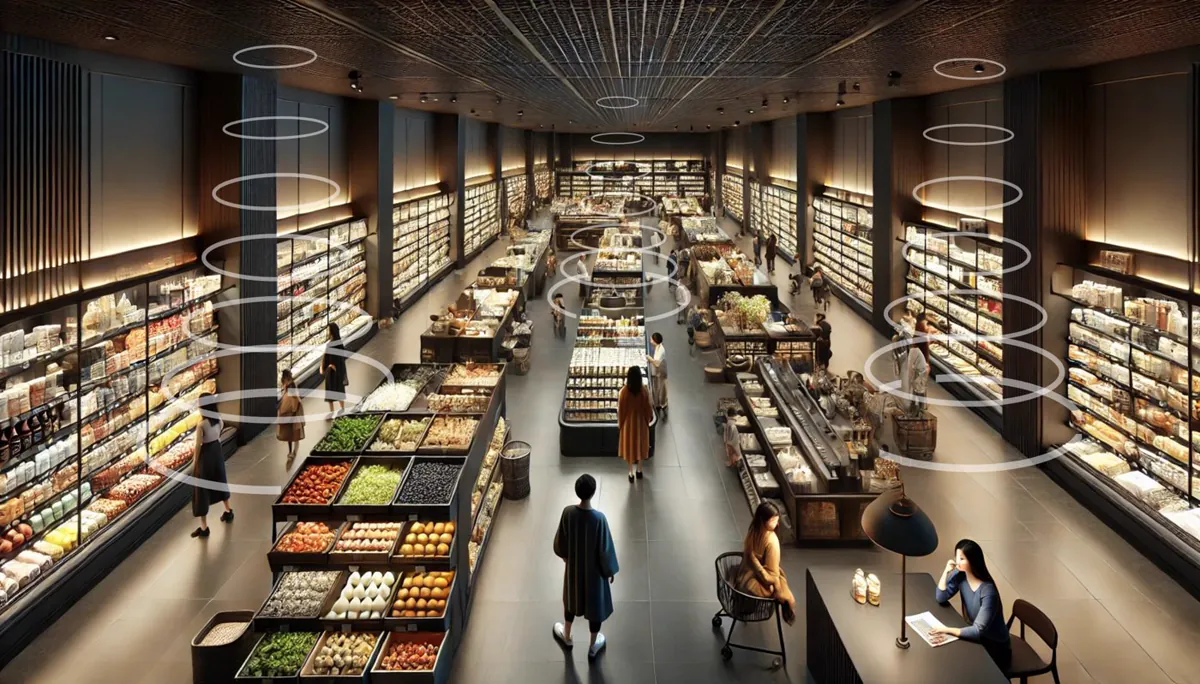
In short
In a clothing store, music changes how long people stay, how fast they walk, and how they feel. Research points to three levers: tempo (slower invites browsing), volume (louder adds energy, quieter relaxes), and fit with your brand and your customer. And since your store changes throughout the day, the music should too. All of it with music that doesn't trigger SACM or SOMEXFON fees.
Walk into three clothing stores in a row and you'll hear three different things: the manager's radio, a hits playlist at full blast, or silence. It's almost never a decision. And yet, in an industry where people buy based on how they feel trying something on, music is part of the product. Here's what the research says and how to apply it.
What the research says
In-store music has been studied for more than 40 years. These are the findings most useful to a clothing store:
- Tempo changes the pace. In a classic supermarket study, Ronald Milliman (Journal of Marketing, 1982) found that with slow music, shoppers walked more slowly and daily sales were higher than with fast music.
- But tempo doesn't work alone. Knöferle and colleagues (Marketing Letters, 2012) found that tempo's effect on sales depends on the music's mode (major or minor): the mix matters more than any single number.
- Volume moves emotion. In a real fashion store, Morrison, Gan, Dubelaar, and Oppewal (Journal of Business Research, 2011) tested loud and soft music, with and without vanilla scent, on young female shoppers: volume and scent influenced their emotions and satisfaction, and that arousal translated into more pleasure, which in turn affected the time and money they spent.
- Familiar music shortens the visit. Yalch and Spangenberg (Journal of Business Research, 2000) found that with familiar music people felt they had shopped longer, but they actually stayed longer with music they didn't know.
- Music suggests what to buy. North, Hargreaves, and McKendrick (Nature, 1997) played French and German music in a supermarket's wine section: on French-music days more French wine sold, and on German-music days, more German wine. Based on their answers, shoppers didn't notice the effect.
An honest caveat: these are studies in specific settings (a supermarket, a fashion store, a lab), not guarantees. But they point the same way: music works even when nobody is listening closely. For the big picture, read What music should I play in my business to sell more?
What to play for your store
Start with your customer, not the genre. A young fashion store doesn't sound like a bridal boutique. Some practical guidelines:
Young and urban fashion
Energetic pop, pop house, or urban. Here Morrison's study is your ally: a slightly more present volume adds energy, as long as people can still talk at the register.
Casual and family
Soft pop, indie, or acoustic at medium volume. Pleasant music that doesn't compete with the conversation between the shopper and whoever came along.
Boutique and premium
Lounge, jazz, or instrumental at low volume. Relaxed rhythms that invite people to browse, touch the fabric, and try things on without rushing.
Two rules that apply to all of them: music is chosen for the shopper, not for whoever is on shift; and if you have several locations, they should sound the same, because sound is part of your brand too.
By time of day: your store at 11 isn't your store at 7
A single playlist all day ignores that your store changes. This is how we usually schedule it:
- Opening. Calm music at low volume, for stocking shelves and welcoming the first customers without rushing.
- Midday. Medium tempo for browsing and trying things on: this is when you want people to stay.
- Peak hours. More energy when the store fills up and the noise rises; adjust the volume so the music holds up without shouting.
- Closing. Slow the pace for the last purchases and so the team can close calmly.
Fitting rooms and the register deserve their own settings: at the register people need to be able to talk, and in fitting rooms the music accompanies a moment of decision. That's why volume zones make sense (we explain them in How many speakers does my business need?) and why it pays to measure, as we cover in Ideal music volume for a business.
Volume, in one sentence
Music should set the mood without competing. If a customer has to raise their voice to ask for a size, it's too loud; if you can't hear it at peak hours, it's too low. As a reference for what volume does: in a Stockholm café, a study published in the Journal of the Academy of Marketing Science found that with music at 70 dB people chose less healthy options than at 55 dB, and attributed it to lower volume being more relaxing. In fashion, the question is what mood you want on your sales floor.
The legal detail: Spotify isn't for your store
Playing commercial hits from Spotify, YouTube, or the radio triggers two fees: SACM for the songs and SOMEXFON for the recordings. For boutiques and clothing stores, the SOMEXFON 2026 rate schedule lists $9,291 a year under 40 m² and $13,850 over 40 m², plus VAT (IVA), per store (all the tables are in SOMEXFON 2026 Rate Schedule). You can run the numbers for your locations with the SOMEXFON calculator.
There's another reason beyond the legal one: music everyone knows is exactly what, according to Yalch and Spangenberg, shortens the actual visit. Original music designed for your store solves both.
At GeoVENN the music is original: we create it ourselves, it isn't registered with SACM or SOMEXFON, and GeoVENN controls 100% of its rights. Every location gets a written license letter, ready to show during an inspection. An honest note: the letter covers GeoVENN music; if you also play radio, Spotify, or well-known commercial music, that isn't covered. See how our Legal Shield works and check out our per-location plans.
Hear how it sounds in music for clothing stores: playlists by style that change on their own with your schedule.
Original playlists by style and time of day, outside the SACM and SOMEXFON repertoire, with a license letter for each location. Try it free for 21 days at 2 locations.
Frequently asked questions
What music should I play in a clothing store?
Music that fits your brand and your customer: energetic pop or urban for young fashion, soft pop or acoustic for casual stores, lounge or jazz at low volume for boutiques. And it should change by time of day: calmer at opening and closing, more energy at peak hours.
Slow or fast music to sell more?
A classic study by Milliman (1982) found that with slow music, supermarket shoppers walked more slowly and sales were higher. Later studies show the effect also depends on the music's mode, so it's worth testing in your own store.
How loud should music be in a clothing store?
Loud enough to set the mood without competing: customers should be able to ask for a size without raising their voice. A study in a fashion store found that volume affects shoppers' emotions and satisfaction, so adjust it by hour and by zone.
Can I play Spotify in my clothing store?
It's not for commercial use. If you play commercial music, SACM and SOMEXFON fees apply; for boutiques, SOMEXFON lists $9,291 a year under 40 m² and $13,850 above that, plus VAT.
Should a store play well-known music?
Not necessarily. Yalch and Spangenberg (2000) found that with familiar music people felt they shopped longer, but they actually stayed longer with music they didn't know.
Sources
- Ronald E. Milliman (1982), Journal of Marketing — Using Background Music to Affect the Behavior of Supermarket Shoppers
- Knöferle, Spangenberg, Herrmann, and Landwehr (2012), Marketing Letters — It is all in the mix: the interactive effect of music tempo and mode on in-store sales
- Morrison, Gan, Dubelaar, and Oppewal (2011), Journal of Business Research — In-store music and aroma influences on shopper behavior and satisfaction
- Yalch and Spangenberg (2000), Journal of Business Research — The effects of music in a retail setting on real and perceived shopping times
- North, Hargreaves, and McKendrick (1997), Nature — In-store music affects product choice
- Biswas, Lund, and Szocs (2019), Journal of the Academy of Marketing Science — Sounds like a healthy retail atmospheric strategy
- SOMEXFON — Rate schedule: boutiques
The findings cited come from studies published in specific settings; results vary by store, location, and customer. Use them as a guide, not a guarantee.