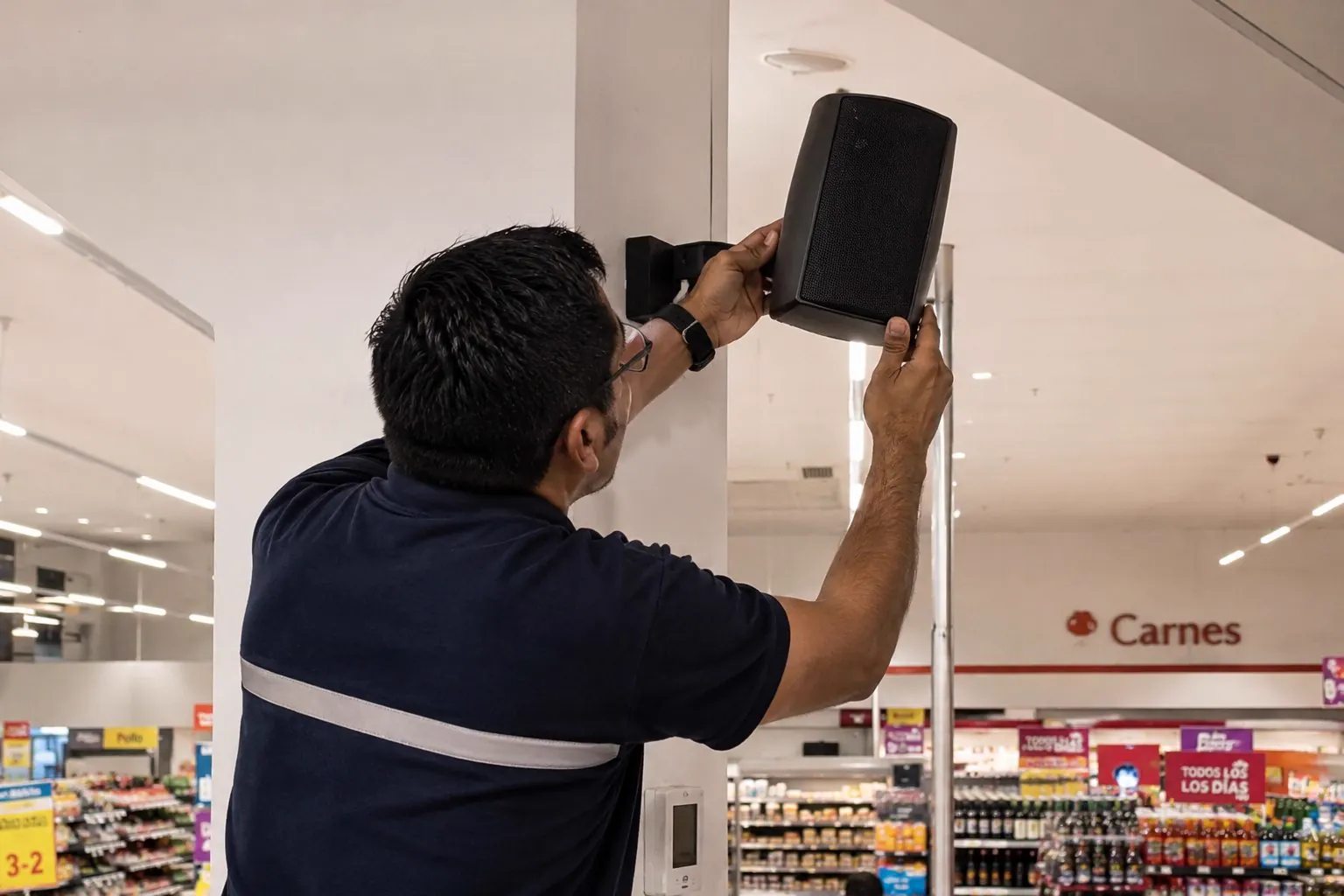
In short
As an industry reference for background music, count on one ceiling speaker for every 9 to 14 m²: a small store of about 40 m² needs roughly 3 to 4, and a midsize one of about 120 m², around 8 to 12. The real number depends on the area, the ceiling height and the noise level of your business, so it comes from a site survey, like the one we do in installation and speakers.
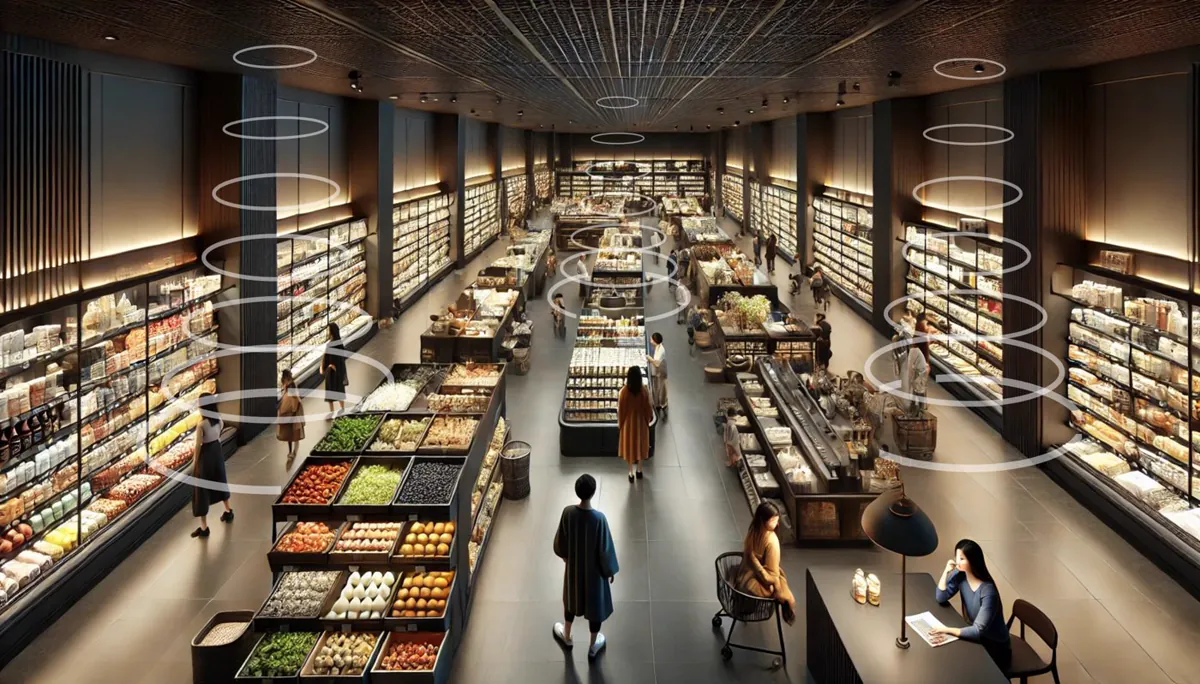
Almost everyone asks the question backwards. It's not about how many speakers fit your budget, but how many it takes for the music to sound just as good throughout your store: at the entrance, at the checkout and in the very last aisle.
The classic mistake is installing two big speakers at full volume. The result: it booms right next to them and can't be heard in the back. The opposite goal, and the right one, is lots of speakers playing low and even. Here's how to get there.
The goal: even coverage, no hot spots
A good background audio system spreads sound evenly. When gaps remain, two problems appear: dead zones (corners where the music gets lost) and hot spots (places where it's too loud next to a speaker). Both wear out customers and staff alike. The fix isn't turning it up: it's distributing it better.
Rule of thumb: customers shouldn't notice where the music is coming from. If they can point to the speaker, they're poorly spaced or too loud.
The quick rule (to start estimating)
For background music, a common industry reference is roughly one ceiling speaker for every 9 to 14 m² (about 100 to 150 square feet). It's a starting point, not a hard rule: it gives you a ballpark, not a reason to buy blind.
Why “roughly”? Because the real number depends on three factors that change everything.
The 3 factors that move the number
- The area to cover. The obvious one: more square meters, more speakers. But simple division isn't enough: you have to factor in the shape of the store, aisles, walls and tall shelving that blocks sound.
- Ceiling height. The most overlooked factor. A high ceiling covers a wider area per speaker, but the sound arrives weaker down below; a low ceiling needs speakers closer together for even coverage. Height changes both the number and the spacing.
- Noise and type of business. A quiet boutique isn't the same as a supermarket with coolers, carts and crowds. The more background noise, the more coverage you need for the music to hold up without having to blast it.
Ceiling, wall or pendant?
The type of speaker also depends on your space. A good design usually combines types by zone.
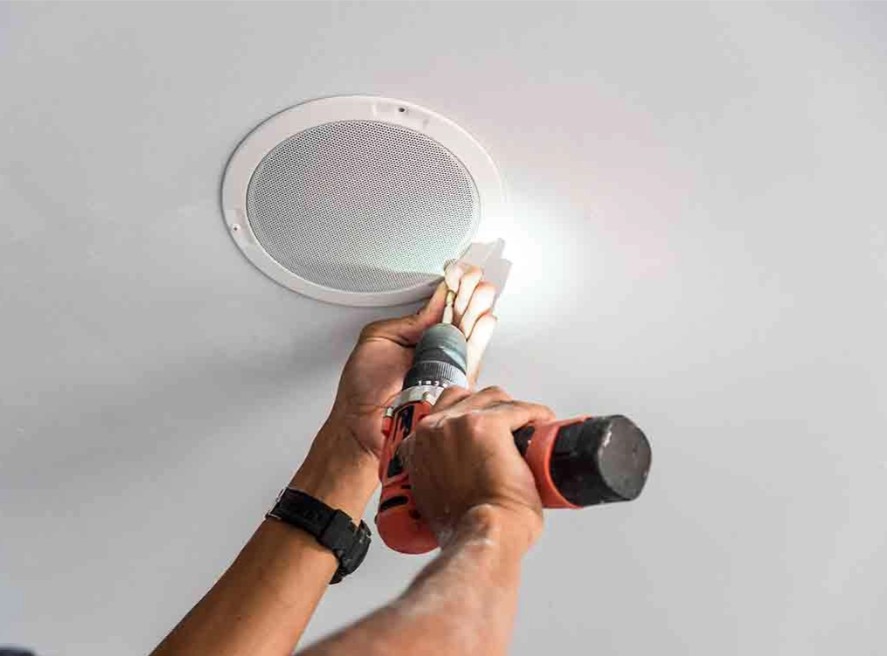
In-ceiling (recessed)
The cleanest, most even option for a standard drop ceiling.
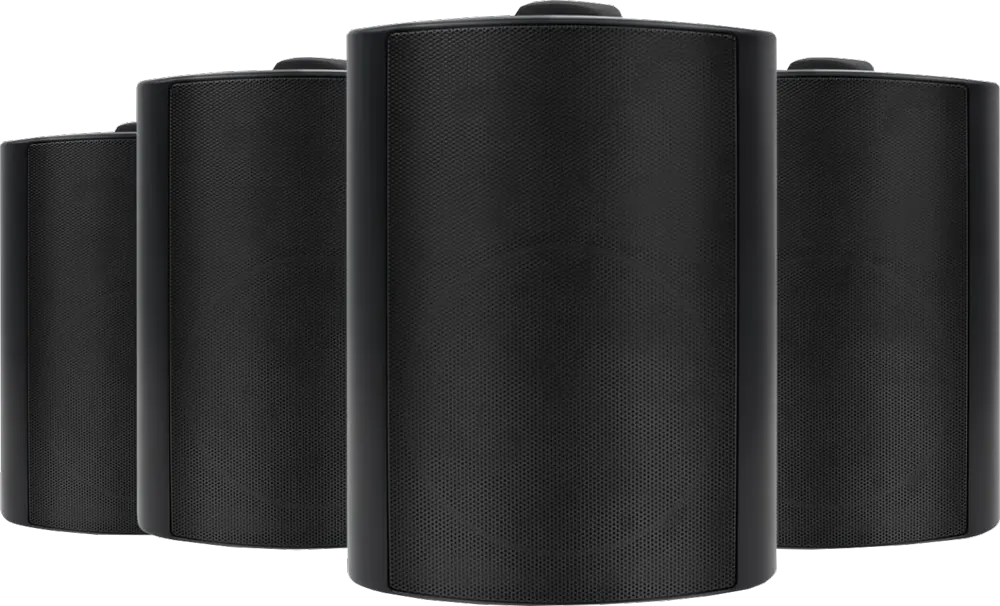
Wall-mount
They work when you can't touch the ceiling.
Pendant or horn
The answer for very high ceilings, warehouses or outdoor areas.
Why businesses use “70V” systems
Here's a technical term worth knowing: businesses rarely use the same kind of connection as a home speaker. They use 70V distributed systems, designed to connect many speakers on one line, with long cable runs and the option to create zones (for example, quieter music at the checkout and more presence on the sales floor). That's what makes even, low-volume sound possible in a large store, something two powerful speakers never achieve.
Zones: your whole store shouldn't sound the same
One detail separates an amateur installation from a professional one: dividing the store into zones with independent control.
Music can run lower and more neutral at the checkout, where customers talk with the cashier, more present on the sales floor, and with its own setting in fitting rooms, the patio or the stockroom. In a restaurant, the dining room and the kitchen don't share a volume; in a store, the entrance and the back don't have to either.
Thinking in zones from the start also lets you advertise smarter: a spot can play only where it makes sense, without taking over the whole store. It's a layer of control that, well planned, costs no more but vastly improves the experience. (If you plan to advertise, read In-store audio ads: how to get started.)
Quick examples (for reference only)
Small store
A corner shop or café, ~40 m²
3 a 4
well spaced
Midsize store
~120 m²
8 a 12
depending on height and layout
Large floor or warehouse
Dozens
in zones, almost always on a 70V system
Again: these are ballpark figures to help you size things up, not a quote. The exact number comes from a site survey.
What to remember
More speakers at low volume > a few at full blast. The right number depends on your area, ceiling height and the noise of your business, not an internet average.
The costliest mistake: buying before measuring
Buying “too many”
It's money down the drain.
Buying “too few”
It leaves you with dead zones you'll have to patch later, almost always at a higher cost.
That's why the smart move isn't guessing with a calculator, but starting from a real site survey of your store: someone measures, factors in height and layout, and designs the speaker placement before installing.
At GeoVENN, that's exactly what we do. We come to your business, measure, design the coverage and leave it installed and sounding even; you don't lift a finger. See how we work in Installation and speakers.
We measure, design and install the ideal coverage for your space, without overspending and with everything ready to play. Try it free for 21 days at 2 locations.
Frequently asked questions
How many speakers do I need per square meter?
For background music, a common industry reference is one ceiling speaker for every 9 to 14 m² (about 100 to 150 square feet). It's a starting point, not a hard rule.
How many speakers does a 40 m² store need?
Around 3 to 4 well-spaced ceiling speakers. A store of about 120 m² takes roughly 8 to 12, depending on ceiling height and layout.
What affects the number of speakers?
Three factors: the area to cover (and the shape of the space), the ceiling height and the background noise of your type of business.
What is a 70V audio system?
It's a distributed system designed to connect many speakers on one line, with long cable runs and the option to create zones with independent volume. It's what businesses use to get even sound at low volume.
Sources
- Totem Acoustic — How Many In-Ceiling Speakers Do You Need?
- XTEN-AV — Commercial Ceiling Speaker Layout Guide
- XTEN-AV — 70V Ceiling Speaker Layout
- Extron — Ceiling Speaker Calculator Guide
- Biamp — Ceiling Loudspeaker Calculator
The figures and examples are general industry references; the actual number and layout depend on a site survey (area, height, materials and type of business). Use them for sizing, not as a final design.