In short
There's no standard for how loud music should be for your customers, but there are solid clues. A study in a café found that at 55 dB people chose healthier food than at 70 dB; another, in bars, found that at 88 dB people drank faster than at 72 dB. For most businesses, background music works between 55 and 70 dB, depending on the type of business and the time of day. And there's a ceiling: NOM-011-STPS requires protecting workers exposed to 85 dB(A) or more.
Volume is the knob that moves the most in a business and gets the least thought. Whoever opens turns it up because "you can't hear it," whoever's serving turns it down because "I can't talk," and in the end it sounds different every day. Here are numbers to decide it with good judgment.
What a decibel is (no formulas)
The decibel (dB) measures how loud a sound is, but not in a straight line: it's a logarithmic scale, so a few more decibels make a big difference. When you see dB(A), it's a measurement adjusted to how the human ear hears; it's the one used by workplace noise standards and most sound level meters.
What matters for your business isn't the exact number, but where and when you measure it: at the customer's ear level, at several points in the space and during normal operation (people, refrigerators, coffee machine).
What studies say about volume
decibels in a Stockholm café. At 55 dB, 32% of items sold were healthy and 42% were not; at 70 dB, 25% versus 52%.
Biswas, Lund and Szocs, 2019decibels in two bars in France. With louder music, customers drank more in less time.
Guéguen et al., 2008volume in a fashion store: it affected shoppers' emotions and satisfaction, and through them their time and spending.
Morrison et al., 2011The café study (Journal of the Academy of Marketing Science; summary in ScienceDaily) explains the effect through relaxation: low volume calms and high volume excites. The bar study (Alcoholism: Clinical & Experimental Research) observed 40 men aged 18 to 25; its authors suggested that high volume increases arousal and reduces conversation, and recommended a moderate volume to owners. The takeaway: volume isn't neutral. Louder speeds things up; softer relaxes. The question is what you want at each moment.
The limit you shouldn't cross: your team
Your customers are there for a while; your team, the whole shift. NOM-011-STPS-2001, on noise in workplaces, sets these maximum exposure times:
| Exposure level | Maximum time allowed |
|---|---|
| 90 dB(A) | 8 hours |
| 93 dB(A) | 4 hours |
| 96 dB(A) | 2 hours |
| 99 dB(A) | 1 hour |
Source: NOM-011-STPS-2001, table A.1 (Official Gazette (DOF), April 17, 2002). The same standard requires hearing protection and a hearing conservation program from 85 dB(A).
A business with well-set background music stays far below those levels. Where you need to be careful is bars, clubs and gym classes, where volume goes up by design. If your team spends the shift near 85 dB(A) there, it's no longer about ambiance: it's about workplace safety.
Volume by type of business: our practical guide
There's no official decibel chart by type of business. These ranges are the reference we use to calibrate our installations, based on the studies above and the NOM-011 ceiling. They're a starting point, not a rule:
| Type of business | Suggested range | Why |
|---|---|---|
| Coffee shop and restaurant | 55 to 65 dB | Table conversation is the product; low volume relaxes and makes people linger. |
| Hotel (lobby) and spa | 50 to 60 dB | Calm and privacy; the music should only be noticed if you listen for it. |
| Supermarket and pharmacy | 55 to 65 dB | Long shopping trips, announcements people can understand and staff under the same music all day. |
| Clothing store | 60 to 70 dB | Depends on the style: more present in youth fashion, softer in a boutique. |
| Bar | 65 to 75 dB | Energy without killing conversation; going higher speeds up consumption and tires people out. |
| Gym (floor) | 70 to 80 dB | The music sets the pace; it goes up in classes, but watch the 85 dB(A) limit for your coaches. |
GeoVENN reference ranges measured at the customer's ear level, with the business in operation. They are not an official standard.
How to measure it in your business
- Use a sound level meter or a sound meter app. Phone apps aren't precision tools, but they're good for comparing zones and times.
- Measure where the customer is: at the entrance, mid-store, at the checkout and in the farthest corner, at ear level.
- Measure twice: when it's quiet and at peak hours. The music has to hold above the noise without going overboard.
- Do the conversation test: if people at the checkout have to repeat themselves, turn it down; if the music disappears at peak hours, turn it up a little.
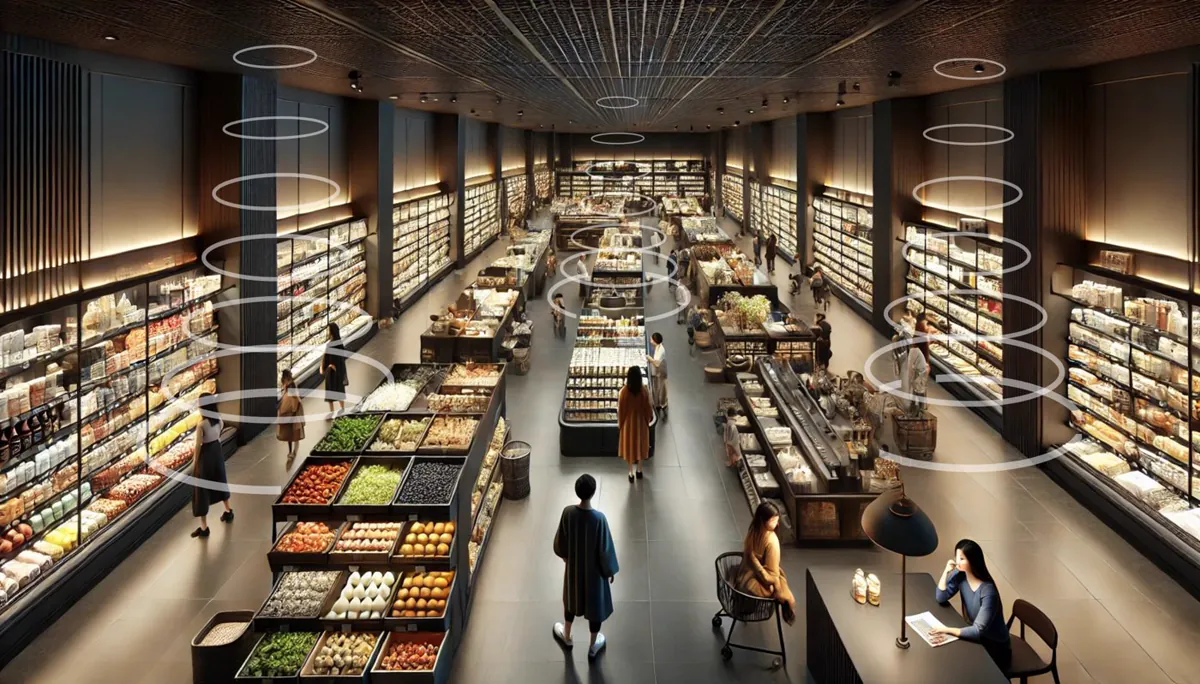
If it's very loud in one spot and you can't hear it in another, the problem isn't the volume: it's the distribution. A few speakers at full blast leave hot spots and dead zones; many speakers at low volume keep the sound even. We explain it in How many speakers does my business need?
Volume has a schedule too
A store at 10 in the morning doesn't sound the same as at 7 at night. What works is lowering it at opening and closing, raising it a little at peak hours and having zones with their own setting (checkout, fitting rooms, patio). The same goes for the music: tempo and energy by time of day, as we cover in Music for clothing stores and in What music should I play in my business to sell more?
At GeoVENN we schedule music by hour, day and location, and during installation we spread out the speakers and calibrate the volume of each zone, so it doesn't depend on who opened that day. And since our music is original, with a license letter for each location, volume is the only thing you have to watch: no SACM, no SOMEXFON.
We measure, place the speakers and calibrate each zone, with original music outside SACM and SOMEXFON. Try it free for 21 days at 2 locations.
Frequently asked questions
How many decibels should music be in a business?
There's no standard for customers, but background music usually works between 55 and 70 dB measured at ear level: lower in coffee shops, restaurants, hotels and pharmacies, and more present in fashion stores, bars and gyms. These are reference ranges, not an official rule.
Does loud music make people consume more?
It can speed up consumption. In a study at two bars in France, with music at 88 dB customers drank more in less time than at 72 dB. In a café, music at 70 dB led people to choose less healthy options than at 55 dB.
What is the noise limit for my employees?
NOM-011-STPS-2001 sets 90 dB(A) as the maximum for an 8-hour shift, and requires hearing protection and a hearing conservation program from 85 dB(A).
How do I measure the music volume in my business?
With a sound level meter or a sound meter app, at the customer's ear level, at several points in the space and at two moments: when it's quiet and at peak hours. If it's loud in one spot and you can't hear it in another, the speakers need to be spread out better.
Should I change the volume during the day?
Yes. It's best to lower it at opening and closing, raise it a little at peak hours and give each zone, like the checkout or fitting rooms, its own setting.
Sources
- Biswas, Lund, and Szocs (2019), Journal of the Academy of Marketing Science — Sounds like a healthy retail atmospheric strategy
- ScienceDaily — Cheeseburger or salad? How music volume impacts your decision (May 24, 2018)
- Guéguen et al. (2008), Alcoholism: Clinical & Experimental Research — Sound level of environmental music and drinking behavior: a field experiment with beer drinkers
- ScienceDaily — Loud music leads to more drinking in less time (Jul 21, 2008)
- Morrison, Gan, Dubelaar, and Oppewal (2011), Journal of Business Research — In-store music and aroma influences on shopper behavior and satisfaction
- Official Gazette (DOF) — NOM-011-STPS-2001, safety and hygiene conditions in workplaces where noise is generated (Apr 17, 2002)
The ranges by type of business are a practical GeoVENN reference, not an official standard. The findings cited come from studies in specific settings. For workplace safety obligations, check the current NOM-011-STPS or consult a specialist.